
Microcement appeared recently in the floorings market, but has already proved itself as a practical material. Its main properties are durability and aesthetics. That is why microcement is used both in industrial and residential premises. And Belarusians are increasingly choosing it for domestic interiors.
What is this material? What are the advantages of a microcement floor? How much does such a coating cost? Our expert Petr Kvach, director of HAUPTMANN in Minsk, which is engaged in manufacture of poured floorings, answers these and other popular questions about the new material.

Microcement? What's the difference between microcement and cement?
— The material is based on cement, but it is more finely ground than conventional construction cement. It also has special polymers added that give the necessary properties: additional strength, elasticity, adhesion (ability to bond with the base). Therefore, it would be more correct to call this compound a cement-polymer mixture. However, the name "microcement" is more widely used.
It was developed in Europe and became popular 7-10 years ago. We have been promoting it in the Belarusian market for about 5 years (we use a German mixture). So, microcement is still a novelty for many people. However the material is very promising.
Is it difficult to lay such a floor?
— We are not talking about laying, but pouring. In fact, this is a kind of poured floors. The process can't be called overcomplicated, though it requires accuracy and strict compliance with the technology. First, we prepare the floor screed: its surface should be smooth and clean. Then cover it with primer and apply the first layer of microcement. After drying, we grind it, clean it from dust and pour the second layer, which we give the desired color and texture. Then again, we wait until the coating dries, and then we apply the final varnish. (Its surface can be made both glossy and matte). The thickness of microcement floor as a result does not exceed a couple of millimeters.
In principle, the pouring can be done by someone with experience in construction. However, we recommend to our clients contractors to whom we trust: their employees have been trained and know how to work with microcement.

A couple of millimeters?! Will it be enough for sure?
— That's all it takes. Required material strength and elasticity is provided by polymer additives and varnish coating. To compare, we pour 2-3 mm thick polymer in factory buildings with high loads: a lot of people walk there, heavy trucks, electric cars move, etc., so for the living room 2 mm is more than enough.
How expensive is it to take care for such a floor?
— In apartment or private home, all maintenance is to renew the varnish layer every few years, depending on the intensity of use. For it gets worn out over time. Although we have experience with stores where there are crowds of people every day (up to 5000 people per day) and the varnish on the micro-cement floor hardly wears off after a few years. However it's better to follow the manufacturer's recommendations and refresh the coating in time.
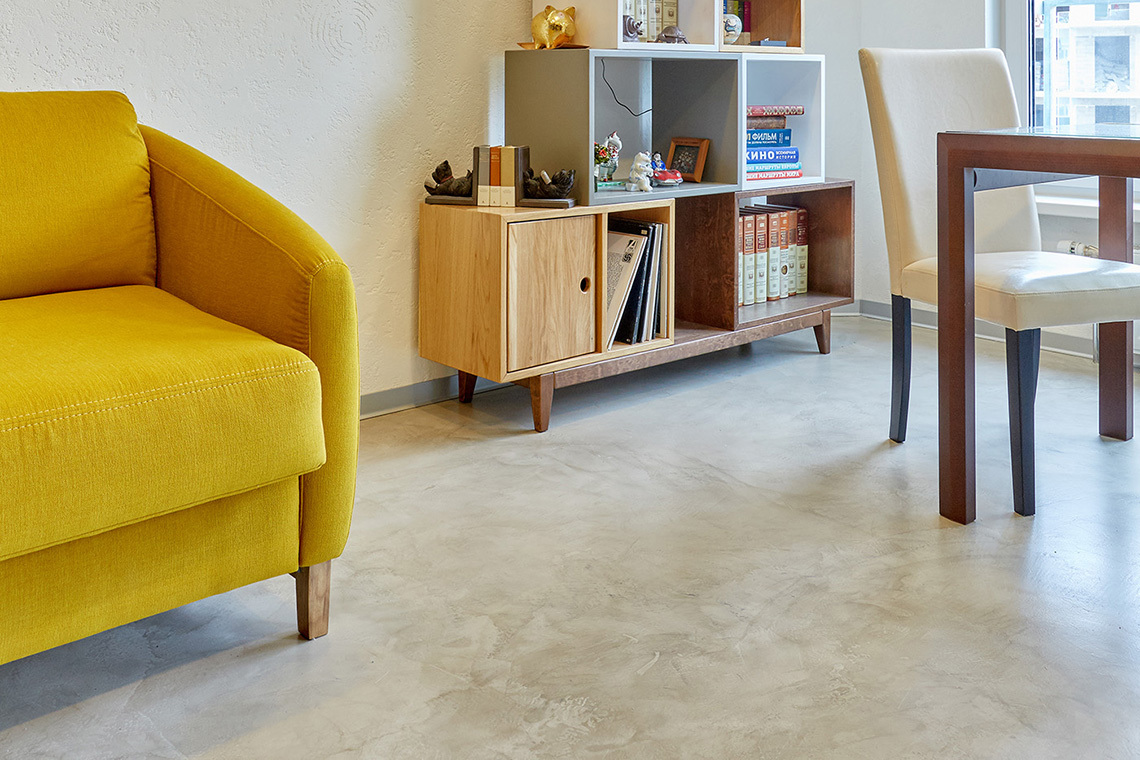
There is no need to use any special detergents to wash your floors. You can safely use those that are sold in hardware stores.
Why do I need microcement if I can lay tile or laminate?
— The most important advantage of microcement is its superior scratch and abrasion resistance compared to, for example, laminate or parquet board. According to this parameter, only tiles can compare to microcement. But it also has a disadvantage: joints, where dirt and microbes can accumulate. And a microcement floor is a one-piece coating.
And since microcement does not abrade, it is practically dust-free. That's why such floors are ordered by many organizations, where the absence of dust is critical for production. It's also a great solution for homes: the less dust - the healthier?
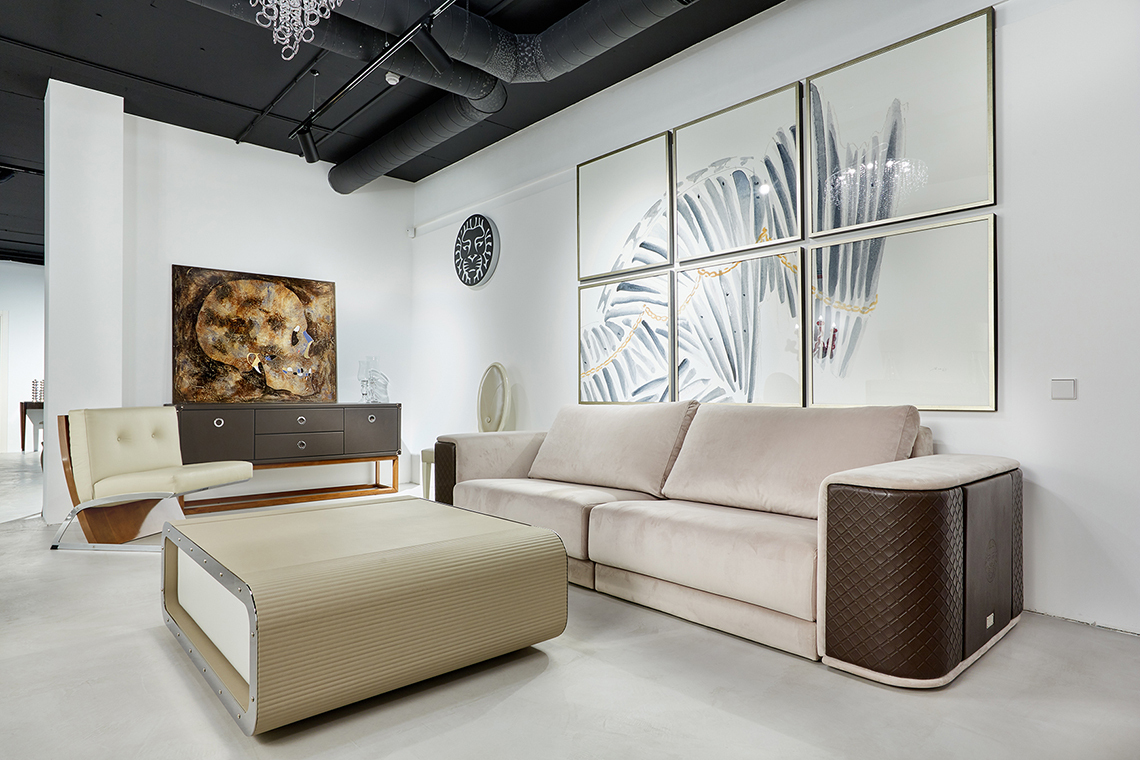
What if I put a hard-to-remove stain on my floor?
— If you spill coffee or wine on the floor, for example, there won't be any stains. The varnish withstands even acids and alkali (if you remove them in time, of course). Microcement is resistant to salt, which we sprinkle on the sidewalks in the winter and which we bring home on our shoes. Therefore, the material can be safely used to decorate hallways.
Microcement is not afraid of water either, so it is used in rooms, in the kitchen and in the bathroom.
And if you're flooded by your neighbors, you don't have to change your floors.
Won't such a floor be slippery?
— Flooring roughness degree is determined in the course of laying and is regulated by GOST. Naturally, in the bathroom, where water is often splashed, rougher floors are poured, and you do not risk slipping.
Is the cement cold?
— Microcement's thermal conductivity is slightly higher than of laminate. But even if you step on the floor barefoot - you will not have the feeling of a hard cold. Walking around barefoot will be pleasant enough.

And what about safety? After all, there are some additives in it..
— The content of polymer additives in the cement mixture is minimal - literally a few percent. And the additives themselves are tested under laboratory conditions. The mixture itself is made in Germany, where environmental requirements are very high. It also has Belarusian hygienic certificate. By the way, the floors in our office are also made of microcement: for several years we have had no complaints.
Can I choose the color I want?
— The color palette is very wide: we pick up any shade you need. As for textures, microcement imitates marble, stone, concrete, rust... This is what our technologists do. If you want, you can make a unique project, and no one else will have exactly the same floors. Before the floor is poured, we make a small sample and give it to the client, so they can see if the chosen color and texture match the interior.

How much does it cost?
— In the end, pouring such a floor costs between 90 and 130 rubles per meter. The cost depends on the base condition, i.e. screed, room size and design solutions. That is, compared to tiles, it is quite a competitive offer. But the microcement floor has no seams, and this is a big advantage. We also have a system of discounts. If we take into account that the material is durable and has a number of positive properties, it is a profitable solution.
In addition, microcement can cover walls, bathroom sink area and even countertops. The cost of covering the walls is lower: the load requirements are not that strict. As you can see, microcement is versatile. That's why I consider it to be the material of the future.
Why should we take a closer look at the microcement?
Compared to other floorings, it has a number of advantages:
- absence of joints;
- resistance to dirt and aggressive substances;
- waterproofing;
- durability without complicated maintenance;
- possibility of individual selection of color and texture;
- versatility: microcement is used for finishing both floors and walls.

HAUPTMANN has been producing flooring materials for 11 years. Using our long-term experience in industrial and civil construction, as well as with technical support of the Polymate ltd research company (Israel), we achieved high product quality and environmental safety.

